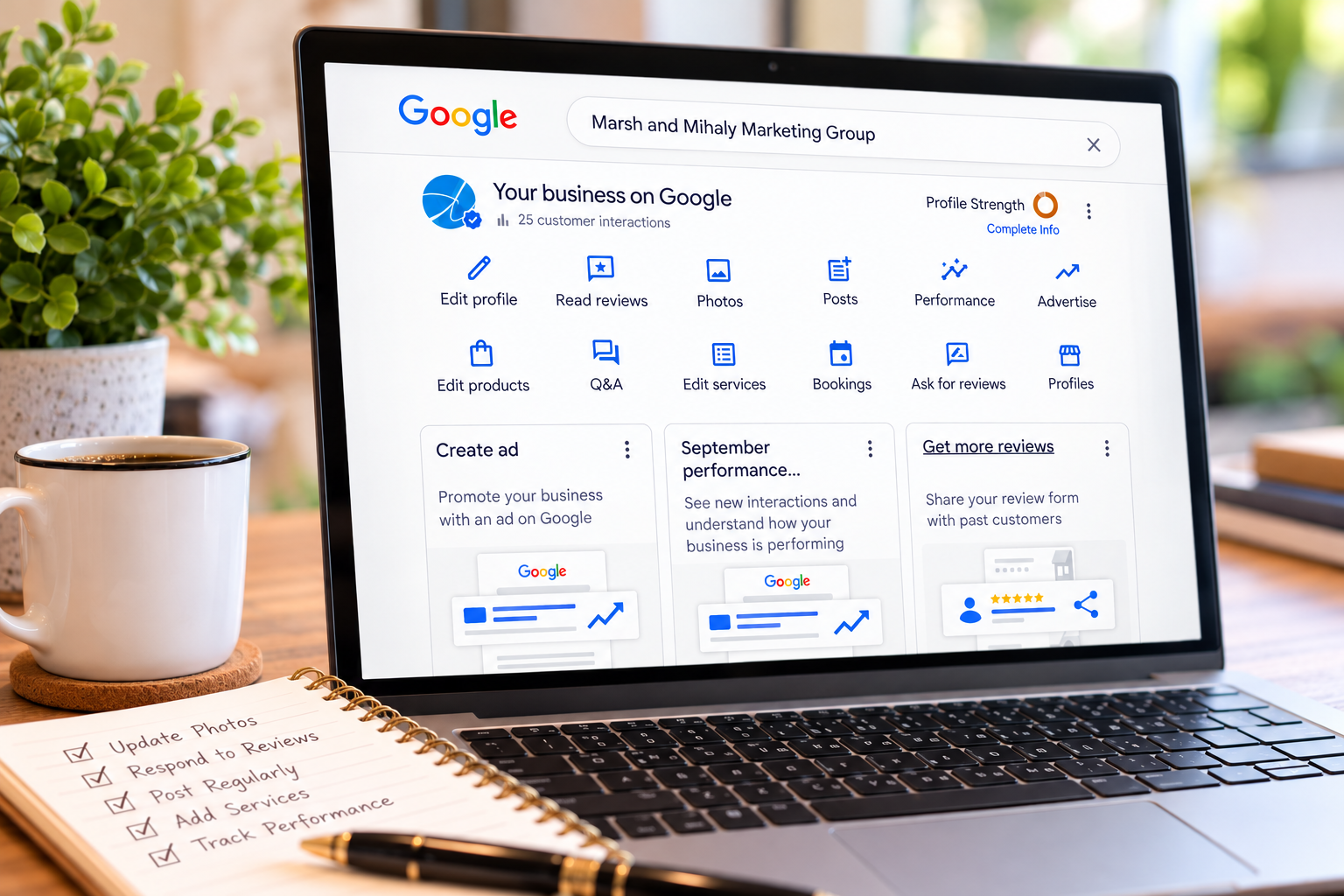
Local SEO for a Central Texas business starts with three practical jobs: keep your business information accurate, explain your services clearly, and show credible evidence of your work. Those jobs support discovery across local search, your website, and AI-assisted research. Each search experience still has its own rules and limitations.
If you run a business in Dripping Springs, Blanco, or New Braunfels, you’ve probably searched for your own services and wondered why another company appeared above yours. Before adding more posts or more city names to your website, it helps to understand what that result is showing you. Then you can decide where your time will do the most good.
Why local search results change from place to place
Google Maps and the local business results within Google Search help people find nearby businesses. Website results give individual pages a chance to answer a search. AI features can assemble information into a response with supporting links. Treat these as related places to be found, each worth checking separately.
Google’s local ranking guidance identifies three main considerations:
- Relevance: how well a business matches what someone is looking for.
- Distance: how far the business is from the person searching.
- Prominence: how well known the business is, informed by signals such as links and reviews.
That explains why a search near your office can look different from one on the other side of town. You can improve the information and evidence available about your business. You can’t turn a distant location into a nearby one by repeating a city name.
Give Google and your customers the same business facts
Start with the details a customer needs to call, visit, or decide whether you serve them. Check your business name, phone number, website link, hours, and primary category. Compare the profile with your website’s contact and service information. Correct anything that could send someone to the wrong place or leave them wondering which information to trust.
Google’s business representation guidelines call for your real-world business name and accurate categories. Adding a string of services and cities to a name that customers don’t actually know you by can violate those guidelines.
Address and service area need particular care. If you travel to customers and don’t serve them at your business address, Google’s service-area guidance says to remove the address from your public profile. Describe the places you actually serve. A service area tells customers where you work; it doesn’t establish an office in every town on the list.
For a business serving several Hill Country communities, useful detail might include where consultations happen, whether customers can visit, and any genuine limits on travel or availability. A precise answer saves everyone a phone call.
Make your website useful to someone choosing a local provider
A potential customer landing on a service page should quickly understand what you do, who you help, where you work, and how to take the next step. Give them enough detail to decide whether a conversation makes sense.
For example, a company that works in both Dripping Springs and New Braunfels could explain how it handles appointments in each area, show relevant completed work with permission, and answer the questions those customers ask before hiring. Those details earn their place because they help a reader.
Separate city pages can be useful when there’s distinct information to share. Swapping a town name into the same generic page adds little. Google’s spam policies on doorway pages warn against pages targeting similar regional searches while funneling visitors to essentially the same destination.
Before commissioning another location page, ask: What would a customer learn here that they couldn’t learn on our main service page? If the answer is thin, strengthen the main page first. Add clear service descriptions, relevant examples, readable headings, and a working contact path.
Your pages also need to be accessible to search engines. If an important service page isn’t appearing at all, have your website partner check discovery and indexing before prescribing more content. Google’s SEO Starter Guide explains those foundations and why improvements take time to show up.
Build local credibility from work you can show
A review, a project example, and a community connection tell different parts of your story. Use each honestly. Ask customers about their actual experience, describe completed work accurately, and mention local involvement when it helps someone understand your business.
Google allows businesses to request reviews, but its review guidance prohibits incentives such as discounts or free products in exchange. Make the request easy with a review link, and keep replies helpful without exposing private customer details.
For project stories, include the customer’s need, the work performed, and any result you can substantiate and have permission to share. Even a modest example can answer a question that a broad claim like ‘excellent service’ leaves open.
A local example: Rollo Insurance in Dripping Springs
Marsh & Mihaly Marketing Group’s published Rollo Insurance client story describes a coordinated approach involving keyword optimization, website performance, and local search visibility. It provides a useful example of the different parts a local SEO plan may need to address.
For your business, the starting point depends on the gap. If customers can’t tell which services you offer, work on the page. If the profile sends them to an old phone number, correct that first. Choose the task that removes a real obstacle.
Where AI search fits into the local picture
Google’s AI Overviews and AI Mode build on its search foundations. Its current guidance for generative AI search emphasizes useful, original content and says there’s no special AI schema or machine-readable file required for inclusion.
The practical recommendation is straightforward: make your business easy to understand. Put clear answers on the pages where customers need them. Support claims with real examples. Keep contact details and service descriptions current. These are worthwhile improvements even when a particular AI response doesn’t mention you.
Other AI platforms have their own systems, so avoid treating one appearance as proof of visibility everywhere. Our AI search optimization guide for Central Texas businesses explores the broader picture. For a local SEO plan, keep the focus on information you can maintain and questions you can answer well.
Choose your next improvement with a local evidence check
You don’t need to fix everything in one sitting. Use this short check to identify a useful starting point, then give that task an owner and a review date.
| What to check | Evidence to gather | Useful next action |
|---|---|---|
| Business facts | Current profile, contact page, and actual hours and service area | Correct conflicting or outdated details. |
| Service fit | Your main service page and questions from recent inquiries | Answer the most important unanswered question. |
| Local proof | A permitted project example, customer review, or real community involvement | Add specific, supportable evidence where it helps a buyer. |
| Contact path | A mobile visit to the page and a test of the contact method | Fix any broken link, confusing instruction, or form problem. |
| Inquiry quality | Recent inquiries, services requested, and locations served | Track whether the right customers are reaching you. |
Keep a simple record of what changed and when. Review comparable periods and consider seasonality, promotions, and other work happening at the same time. That gives you a more useful conversation than checking your own ranking every morning.
Google’s Business Profile performance report can show actions such as website clicks, direction requests, and call-button clicks. A call-button click isn’t proof of an answered call or a qualified lead. Pair those counts with what your team learns from actual inquiries: the service requested, the customer’s location, and whether the conversation moves forward.
Give your local search plan a clear next step
Your next improvement should have a clear reason behind it. Fix inaccurate information, fill a gap on a service page, or make good work easier to evaluate. Once you’ve chosen the priority, decide who owns it and how you’ll judge progress.
Marsh & Mihaly brings local SEO and Google Business Profile work together with website content and broader marketing strategy through our SEO and marketing services. If you’d like help deciding where to start, talk with Dee and Dana about your local visibility. We’ll start with your business, the customers you want to reach, and the work that deserves attention first.
Frequently asked questions about local SEO
Why does my business rank differently in different towns?
Distance is one of Google’s main local ranking considerations, alongside relevance and prominence. A search near your business can produce different results from one farther away. Check results in the context of the searcher’s location and the service they’re seeking.
Will adding more service areas or city pages make me rank across the Hill Country?
Neither creates a business location in those places. List the areas you actually serve, and create a separate city page when you have useful, distinct information for that audience. Treat geographic coverage as a customer promise you can fulfill.
How often should I post updates to my Google Business Profile?
Choose a schedule you can maintain with useful, accurate updates. Google’s local ranking guidance doesn’t prescribe a posting frequency that guarantees stronger rankings. A current offer, relevant project, or meaningful business update should have a customer purpose.
Do I need special markup to appear in Google’s AI search features?
Google says no special AI markup is required. Focus on accessible pages, helpful original information, and clear business details. Structured data should accurately describe your content; it doesn’t guarantee that an AI feature will select it.
How will I know whether local SEO is helping the business?
Look at relevant search visibility and profile interactions alongside qualified calls, forms, and conversations. Ask whether inquiries match your services and service area. Record changes and compare results over time without attributing every gain or loss to a single update.